
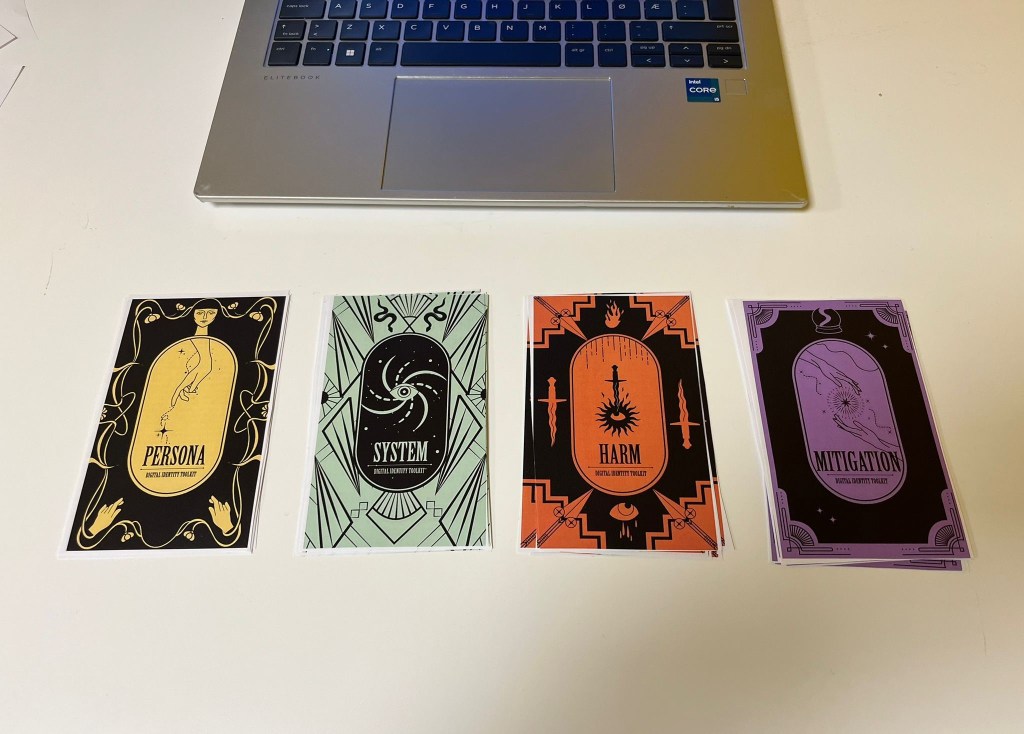
Today, my students in the course of ICTs and Global Inequalities at the University of Oslo found a different scenario from the usual: four card stacks names Persona, System, Harm and Mitigation, ready to turn the class into a “choose your own adventure” game aimed at discovering the harmful effects of Digital ID systems, and their mitigation. Here is a short story of how it went!
I love gamified learning. I am especially keen for the interactive experience it affords, the learning-by-doing practice, the application of theoretical concepts to reality. When I interviewed the one and only Marianne Diaz Hernandez for my book Unfair ID, among many, extremely insightful notes, she shared with me the construction of the Digital ID Toolkit, a game constructed with the #WhyID initiative of Access Now for players to experience real-life scenaria of unfairness in digital ID. As someone who likes her games, but was not raised with gamified learning, I embraced the gamification of my course at University of Oslo as a route to conveying difficult concepts through relatable situations, and I am so happy to be able to report on this experience today.
What is the Digital ID Toolkit?
The Digital ID toolkit is a “choose your own adventure game” consisting of four stages: Persona, System, Harm and Mitigation. At the beginning of the game, each player (or team) chooses a Persona card, which describes a situation (fictitional persona; real-life scenario) of predicament in relation to digital ID. Let me share one of the persona scenaria my students dealt with today:
Anya is a trans nonbinary citizen of Iceland with a nonbinary gender marker on their passport. Anya needs to move to Italy for work, and Italy requires foreigners to carry identification at all times. The Italian ID card is intended for both digital and physical use, with biometric data printed on the card and stored on a contactless chip. The ID includes full name, place and date of birth, the holder’s picture, and a fingerprint from each hand, and only allows for male or female gender markers. The card is not mandatory for Italian citizens but is the ID form most widely accepted in both the public and private sectors. The residency permit available to eligible foreigners is also digital and does not allow for nonbinary markers. If public security officers ask a person to identify themselves and are not satisfied by the answer, they may hold the person in custody until their identity is ascertained. The discrepancy between gender markers on Anya’s Icelandic and Italian IDs as well as the forced adoption of a gender marker with which Anya does not identify both increase Anya’s risk of being subjected to further investigation.
What is gonna happen to Anya? The students will discover through a choose-your-own-adventure journey, which consists of three building blocks:
– System – the students draw a system card, which lists details of the digital identity system that, for instance, Anya is experiencing. Such systems – including biometrics, centralised systems, databases of identity – bear features that crystallise the adverse outcomes that Anya is experiencing: for instance, the absence of their identity in the drop-down menu they encounter, and the hard consequences of not identifying with one of the options available.
– Harm – based on the type of system they selected, the students draw a harm card, which details the negative consequences of being implied in the same system. For instance, Anya’s non-recognised identity leads to very material risks of not being able to apply for a job in her host country, of not being visible to the state, but also, on the personal and emotional level, of being subjected to dehumanisation, reducing her identity to a bundle of data that cannot communicate the predicament she is in. At this point, it is mitigation that needs to be looked at.
– Mitigation – as a final step, the students draw a mitigation card (and we didn’t get there because we spent long time on the system-harm link!), where they can explore different routes to mitigation of the harm suffered by the person. What routes to mitigation does Anya have? Advocacy of non-binary, queer rights; unionisation; data minimisation (as in, systems that capture only the essential data points of the human being, without interceding more than those). The final step is important because it conveys a central message: if we want to understand the ways to tackle digital ID harm, we need first of all to see how that harm happens, and then link the properties of ID platforms to specific degenerative outcomes, to imagine and craft mitigation.
Today’s class was a generative experience of ID tales and memories. I teach a class of internationals (being myself an international resident of Norway) and the way the stories of the ID toolkit overlapped with the students’, the appraisal of the harmful mechanisms, the creative imagination of ways out of ID oppression, have been a great lesson for me, and I am so happy that the #WhyID initiative made this possible.
Now, on to write my lecture on biometric borders based on today’s insights. It’s 21.08 here in Oslo and I never felt so motivated. Never stop learning!





 Unfair ID