Not a Better World

We are nowhere near “making a better world” with digital identity. But research on resistance to it, and especially to the centralised model of digital identification and authentication, offers routes to imagine and build up such a world.

My research field, Information and Communication Technology for Development (ICT4D), has many seminal works to rely on. Dating back to the late 1980s, but with works on computing in low-income countries already published from the 1960s, the field was born with the underlying assumption that ICTs – a novel object, by the time of the field’s foundation – afforded the potential to generate “progress” and prosperity in less wealthy regions of the world. The field’s name effectively includes a finalistic term – it is about ICTs for development, not barely in a context where “development” would be arguably beneficial, at least within the technlology-for-development logic of the early days. The enthusiastic undertones with which the field was born have led ICT4D research to ask, are we making a better world with ICTs?

Thinking of the early days of the field, views on the making of a “better world” were supported by optimistic, but at the same time well-contextualised, stances on what technology could do “for” development. Trying to elicit the unspelled, but core assumptions of the early days of ICT4D, results in at least three statements: first, the idea of “development” now widely contested, in virtue of the colonial undertones its genealogy carried, was born as assumed to be intrinsically good, rather than generating asymmetric benefits and harm on its intended subjects. Second, the idea that ICTs were (at least capable of) being a carrier of such good “development” was dominant, and informed the actions of researchers and practitioners as the new tech-for-development philosophy picked up. Third, the patronising term “developing countries” was taken as good and well usable, with little or no problematisation of its meaning. All of this within a technology-transfer logic where “developing” countries could be, for the good of all, “modernised” through ICTs.

The ICT4D research of today, however, looks very different. Thirty-plus years of evolution of the discipline, with many stories of technology transfer and increasingly, of technology being embedded in country politics and citizens’ work, illuminated the extent to which ICTs could “make a better world” for their intended beneficiaries. Stories of digitally induced harm – described by Heeks (2022) as adverse digital incorporation, where technology hurts rather than benefitting its users – contextualised the shift from a logic centred on providing ICTs to the non-connected to one aimed at protecting the connected from the harm that digital connectivity causes on them. From a field centred on “bridging the digital divide”, we got more and more on the way to becoming a field centred on combating the injustices produced, and perpetuated, on already vulnerable people through digitalisation.

Critical research on digital identity belongs to this new, critically informed ICT4D. Or better, it participates in it, illuminating the injustices produced by digital identity systems and the routes to resistance developed on them.

Digital identity research is permeated with stories of harm. To the point that frameworks on the theoretical link between digital identity and human development are used to illustrate the ruptures that such a link meets in practice. To the point that digital identity schemes have been shown, by a recent report by the Centre for Human Rights and Global Justice at New York University, to be linked to human right violations, defying and effectively countering the identity-for-development logic that informs national and supranational digital identity schemes. In its world at the interface among multiple fields, drawing on different theories to make sense of people’s experience of identification, digital identity research is a critical memorandum ow how we are not, in many ways, making a better world with ICTs.

But it is also a memorandum of the opposite. That is, on the shape of the world that can come.

Community health clinic, Malawi, January 2023

Digital identity research is not only about oppression. A large, continuously expanding part of it is about what can be built against systems that reduce people to machine-readable data, which subordinate people’s universal rights to enrolment in a biometric or demographic database. I have just returned from Malawi, where scannable barcodes are being proposed to help Health Surveillance Assistants (HSAs) capable of independently retrieving patient history. Back in India I have listened to the story of Tamil Nadu, a state where smart cards, usable from multiple household members, have been seen to bypass Aadhaar’ biometric recognition. Resistance does not always take the form of protest that it has taken, for instance, in biometric SIM linking in the Philippines recently. Resistance starts from small acts of solidarity, and from technologies that, more or less directly, challenge the centralised model of digital identification and authentication.

So it is not, in good essence, a “better world” that we are making with digital identity. Exclusions and undue surveillance, culminating in human right violations that can be dangerous and even deadly, are very much produced by it. But ICT4D research is not only about injustice. It is also about resistance, at least in equal measure. And it is through that resistance that the much longed “better world” can be made.

Misplaced Research

Today I tell a tale of misplaced research. “Misplaced” in the etymological sense as “conducted in the wrong place”, as a Reviewer once wrote. As it happens, from that perspective my whole research is “misplaced”, as it takes place at the very interface where people meet the technologies governing essential livelihoods. And as it happens, my “misplacement” will keep going.

“Your research is misplaced”, wrote the Reviewer.

(One for fellow academics: believe it or not, this was not Reviewer 2, no. It was the unsuspectable, cosy, otherwise kind and constructive Reviewer 1).

They had a point, and it was an etymological one. In their view, my research was not “misplaced” metaphorically, but in a very physical way. My paper was on the encounter between people and technology in India’s Public Distribution System, specifically in the ration shops where people meet the state through the technology that provides (or denies) their food rations. Here in Malawi, the project I am a part of studies patient records inside the community clinics, where the patient physically encounters the community health worker who deals with their case.

Road to Mangamba, Malawi, January 2023

I can’t hide being deeply inspired by Corbridge et al’s (2005) book on Seeing the State in all my research. As the book argues, “the state” is not experienced at an abstract level. It is lived directly, concretely, in its direct manifestations: it is the policeman patrolling the streets, violently evicting homeless people in absence of a proof of address. It is the government officer checking documents to access a given benefit, the ration dealer enabling, or denying, access to food rations for people. Nothing is abstract in “the State”. Encounters with it, through which images of it are formed, are very real and material, conditioning important aspects of people’s lives.

But the Reviewer expressed a clear judgment. My research is misplaced.

It is so, they wrote, because it does not take place at the point where policy decisions are made. And if you study biometrics in a large food security system, you kind of need to sit at, or at least research, the decision making point, where food policies are shaped. A research that takes place at the last mile, where the user encounters the system in the form of food rations, ration dealers, or community health workers, can only give you a partial, even distorted view of reality. No social protection research, concludes Reviewer 1, should take into account an actor alone. It would have been good to go to Delhi, Reviewer 1 concluded, to see what the echelons of the system effectively say about it.

And now eight years later, I politely say it. Reviewer 1 was wrong.

As social protection researchers, we investigate technologies that are deeply embedded in human lives and livelihoods. The “last mile”, as they called it (and as how important development studies research calls it as well), is completely not “last” when it comes to people’s experience. “Last” as it may be, it is that “mile” that informs people’s contact with service providers: it is here that vital entitlements of food or cash are given, or denied due to authentication failure. It is here that health services are accessed, that medical personnel handles people’s conditions or those of their loved ones. In the last mile, lived experience happens: that of a food programme that delivers rations, a health service that cures residents, a humanitarian programme that assists displaced people. Here at the last mile, the individual interfaces in person with “the technology” on which the bigger echelons have the power to decide on.

True, we may miss something by sitting at the interface. We may lose some action at the upper decisional layers, while spending long days in the field figuring out how people really encounter state-mediating technologies, how they relate to them and experience their ability to guarantee, or deny, access to crucial livelihood generating services. We could move our research to the upper echelons instead, take an owners’ perspective on the platformised systems through which social protection programmes are increasingly provided.

We could, I could. But I don’t, because my research is the interface. In Malawi as in India, as in all places I go, my work is informed by how people live the technology, and by how “the State” becomes real out of its lived human-technology manifestations. Only such encounters, structured by the technologies of rule that govern people’s interaction with providers, give the state a tangible, researchable physical manifestation.

Be it right or wrong, I can’t do it in any other way.

Registration Matters

Purchasing and activating my SIM card in Malawi was a highly structured, computerised process. My conversation with the registering agent reminded me of the importance of understanding registration, and not just authentication, when studying digital identity policies.

Two things struck me about the process of registering a SIM card in Zomba, Malawi. As one of the 155 countries that, as of January 2020, had mandatory SIM registration laws, in Malawi the provision of personal information and a valid identity document is required for purchasing and activating a SIM card for mobile services. In the awareness of this, and of the problematic consequences of mandatory SIM registration on user data treatment and risk of exclusion from services, two elements of the process experienced here struck me as notable.

First, even for a foreigner whose data are not checked for correspondance to a national ID database, the process is extremely structured. Ahmed, who registered my SIM card in his streetside kiosk in Zomba, shows me every step of it: he first needs my personal details, including a document identification number (the number of my Italian driving licence is recognised as “invalid number”, whereas that of my Italian passport allows us to move to the next step). Only at that point comes the request of a picture of the document, a frequently asked one when it comes to SIM registration. But the fields requested to fulfil the process are rigorous and unallowing for manual entry, where a driving licence number, valid or not, would possibly have fit. A form of control of the document’s conformity to a valid passport is designed in the standards themselves, very different from the paper forms that previous SIM registrations have made me used to.

Airtime, data and SIM registration kiosks, Zomba, Malawi, January 2023

Second, the importance of SIM registration is remarkable. Kiosks of Airtel and Mpamba are all over the streets, and Ahmed tells me about the frustration encountered when, following every step of the procedure for activating a client’s SIM, it ultimately does not work (at the first attempt, even my phone shows an “unknown error” only apparently causing inability to activate the SIM, which a second attempt corrects). Unknown errors, says Ahmed, are unpredictable and can pop up during registration, effectively making SIM activation undoable. The uncertainty connected to activation – reminiscent of that described, among others, by Chaudhuri (2021) on biometric delivery of food rations in India’s Jharkhand – joins a discourse interrogating the consequences of insecurity in practices that, like the ability to access mobile services here, are crucial to basic operations of daily life.

I have just arrived here. A whole new discovery to begin.

But my encounter with Ahmed, and with my new SIM used as hotspot as I write this post, made me think of something that I sometime forget when studying digital ID. A lot of our research – definitely, the focal point of my research since 2014 – is on authentication practices, defined as the process of asserting an identity previously established during identification. Authentication at the point of access – of government services, social protection, humanitarian provisions – is crucial as it determines authorisation or not to receive a given service, which can be as crucial as food rations, social cash or emergency assistance to needful groups. In previous work I have argued that the authentication-authorisation nexus is the crucial bit where legal injustice occurs, and the point whose breakage deprives individuals of essential rights.

And here comes the self critical point. Such an argument risks to exclude registration. Or at least, to neglect the effects generated not by failed authentication with a system, but with the bare inability to register for it. Directly connected to that argument are the consequences of making registration, and not authentication, conditional to identification with a national ID database. Consequences that have shown the risks connected to the SIM-ID link, and the consequent fear among affected users.

With SIM registration protests recently erupted in the Philippines, and increased concerns raised on the use of biometrics for SIM card registry, the primary step of digital identity – the very registration of the individual’s details in a database subjected to different protection policies – reminds me of the importance that all our research, especially that focused on accessing services or having them denied based on the step of authentication, is fundamentally predicated on registration processes that we cannot neglect. And to which I make a note to self, to dedicate more explicit attention in the next projects.

Encountering the State

The ration shop is where the state is physically encountered by users of India’s Public Distribution System, the country’s largest food security programme. In this article I reflect on being in the ration shop, encountering the state in the form of the allowance, or denial, of goods that takes place within this crucial interface.

“Why do you spend so much time in ration shops?”

This is a question I got many times during fieldwork. Since my early, pre-Aadhaar studies of the Public Distribution System, India’s largest food security scheme, my questions have been in terms of what happens when an essential anti-poverty scheme is computerised. That is, when a food security programme that has long been paper-based, centred on transactions occurring through physical documents – called ration cards and enabling users to collect highly subsidised food rations – becomes digital, both in its front and back-end components. One fact is that, at the back end, much was happening way before biometric identification was introduced, across multiple states, in the ration shops where food rations are collected.

In Kerala, where my 2011-2012 fieldwork took place, a software called TETRAPDS (Targeted, Efficient, Transparent Rationing and Allocation Public Distribution System) was conceived the first decade of the 2000s. Far from being centred on the front-end, where the PDS user encounters the ration dealer, TETRAPDS consisted of three back-end and only one front-end modules. The three back-end modules covered the phases of ration card processing, allocation of goods, and monitoring of ration shop inspections. All these were crucial for the management of the country’s largest food security scheme. More specifically:

– A Ration Card Management System (RCMS) was a workflow-based application where users could apply for a ration card (or for a change in their existing, household-based card, for example when adding a new family member or forming a new household). Upon reception of the online application, RCMS would get it processed by the Collector of Rationing and delivered through the local Taluk Supply Office, the state bureau in charge of ration card delivery. While protagonist of a large backlog in 2011, RCMS was designed for automatising one of the most important processes in the PDS, that in which users were enabled to receive the physical document that enabled them to access food rations.

– An Allocation of Commodities module allowed the Collector of Rationing to ensure correct allocation of goods to ration shops across the state, based on the theoretical requirement. This module was based on Allocation 2.0, an application for the allocation of PDS goods to ration shops across the 14 districts of Kerala. With a cardholder database revealing  the number of households registered with each ration dealer, the allocation module was designed to solve a dilemma that deeply affected the PDS: namely, how to distribute commodities in such a way that all users of the PDS in the state would be served. Years later, the Aadhaar-based PDS would have transformed this function through calculations enabled by biometric point-of-sale machines.

– An Inspection Monitoring System registered the outcomes of controls made by rationing inspectors, officials in charge of checking the regularity of sales conducted in the ration shops. With issues of leakage to non-poor households largely affecting the scheme, keeping a record of the activity of rationing inspectors was important to the state’s programme management. While not continuously implemented across the state, the Inspection Monitoring module revealed the importance of infusing a control component in the system, a control that subsequent, Aadhaar-based versions of the PDS linked to the amount of goods sold monthly by each ration shop to Aadhaar-registered users.

There was indeed a front-end module, called WebPDS. This was a website for the Food and Civil Supply Department to communicate with PDS beneficiaries. While providing information on the scheme, PDS food prices and other relevant points for users, this module was not “front-end” in the sense that it took place in the ration shops where rations are collected. It was so in the sense of providing relevant information to users, information that, at a time preceding widespread mobile governance, was largely accessed through the public-private telecentres diffused through the whole state.

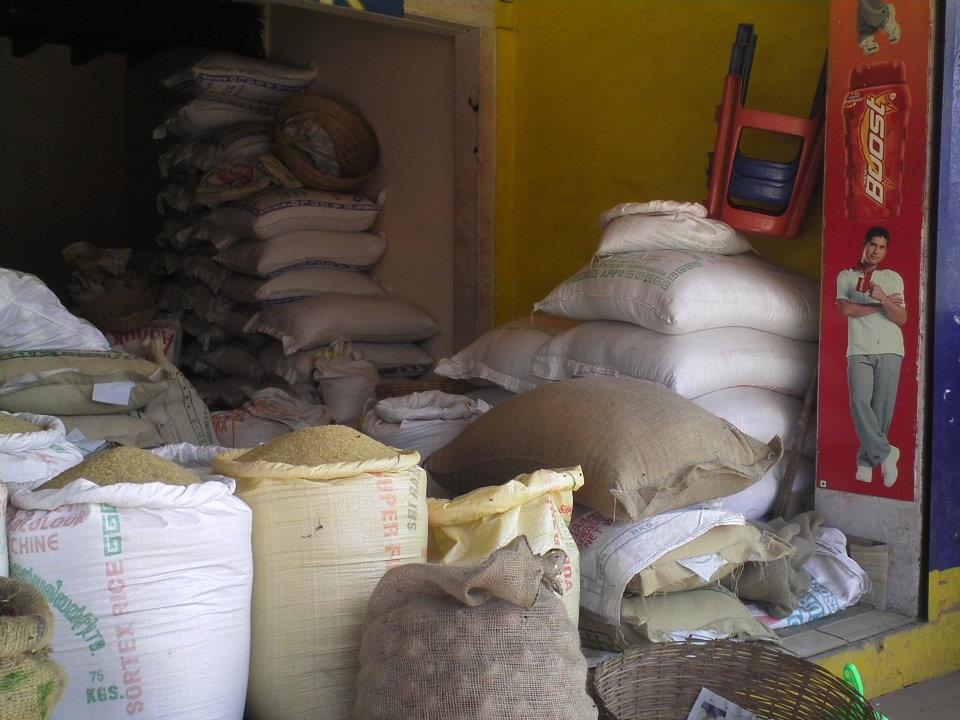
Food supplies, Taliparamba municipality, Kerala, November 2011

But then, with such a large back-end machinery, why spend so long time in ration shops?

The answer lies in how image formation – that is, how users form their own image of the state behind anti-poverty schemes – takes place. Inspiring this view is Corbridge et al.’s (2005) philosophy of seeing the state” through encounters with it, encounters that, far from being abstract, are materialised in the people, bureaus and institutions that represent it. In the Kerala PDS, “the state” is not the abstract entity behind high subsidisation of goods to below-poverty-line users. It is the ration dealer, the material encounter with them, the physicality of the shop where people stand in line to be able to collect their monthly rations. When the biometric PDS came, and with it the exclusions denounced by large parts of the literature, the state remained entrenched in the materiality of encounters enabling or disabling people’s access to vital commodities.

And this is why I sit so long in ration shops. Because it is here, in the materiality of encounters with ration dealers and the machinery coming with PDS transactions, that the state is encountered. Whatever discussion is made of the abstraction behind it, of the subsidy-giving or denying entity that it represents, it is in the materiality of ration shop transactions that the state is met. And for us digital identity researchers, preoccupied with the large infrastructure that precede the state-citizen encounter, it is all too simple to neglect this human dimension: a dimension that is, however, the heart of the state-citizen encounter. And the one in which to sit, for as long as needed, to understand how this encounter is made and shaped by technologies and the politics behind them.

Behind Biometrics

What is the politics of anti-poverty artefacts? In this article I examine it with examples from the early history of the biometric Public Distribution System (PDS) in India, tracing links between today’s Aadhaar-based system and the policy of conditional inclusion that the structural adjustment of the 1990s imposed.

I have recently participated in an extremely enriching event, Digital Urban Infrastructures, organised by colleagues at the University of Twente. A colleague on my same panel asked an important question: what is behind biometrics in anti-poverty programmes?

Based on my research on the datafication of India’s Public Distribution System (PDS), I had just argued that biometric recognition of users inscribes a very clear logic in anti-poverty schemes. It is a logic centred on combating inclusion errors, meaning the erroneous inclusion of non-entitled users in anti-poverty schemes, rather than exclusion errors, meaning the erroneous exclusion of entitled users. Such a logic inspires the biometric transformation of India’s PDS, where Aadhaar-based recognition denies access to non-entitled users, but does not take any action to give access to those who, while entitled, are erroneously excluded from the system. While such a move is friendly to the fiscal burden concerns that have long pertained to the PDS, its consequences are reflected in the perpetuation of stories of user exclusion, told in this blog and in econometric studies of the Aadhaar-based PDS.

But then, what is behind biometrics in anti-poverty schemes, and behind their consequences?

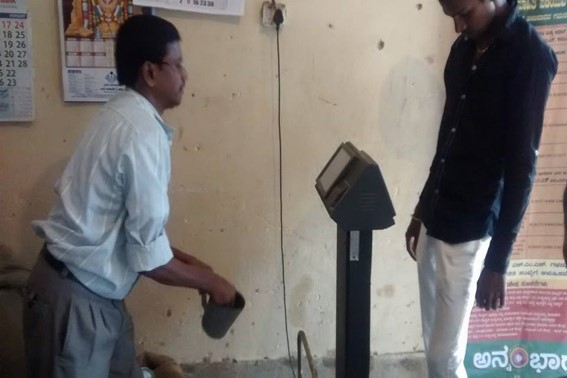
As information systems research has long argued, policy choices are deeply inscribed in technology. In an older piece of research with Amit Prakash, we have sustained this point: anti-poverty artefacts are shaped by the politics that lies behind them, and enact policy decisions that deeply and directly affect their users. In our work, the “politics of anti-poverty artefacts” was illustrated through a pre-Aadhaar case of point-of-sale machines in the state of Karnataka, where a weighing scale connected to speakers announced exactly how much was being sold at each transaction. The fact that we found the point-of-sale machine speakers muted, in most of the ration shops we visited, spoke about ration dealers’ reaction to the policy inscribed in the machines: at the same time, the presence of a paper register, to be used by ration dealers when the point-of-sale machine did not work, revealed the intention to still give rations to those users who were entitled and still not recognised.

PDS transaction through the weighing point of sale machine, Bengaluru, August 2014

The question from the colleague at Twente led me to look back into the anti-poverty policy of the PDS, and note how a policy that prioritises inclusion errors – as opposed to the fight to exclusion ones – finds its origins well before Aadhaar. As early as the 1990s, India suffered a fiscal crisis that turned the PDS, back then a universal food security programme, into a narrowly targeted one, induced by the stringent recommendations imposed by World Bank advisors. Doing away with a universal policy, with the one exception of the Tamil Nadu state, resulted in the distinction of subsidy between Below-Poverty-Line (BPL) residents and Above-Poverty-Line (APL) ones, for whom only a meagre subsidy, approaching the market price, remained into place. The institution in 2000 of Antyodaya Anna Yojana (AAY), involving larger quantities of subsidy for the poorest of the poor, complemented a policy that effectively subjected remaining in the PDS to proven poverty status.

This policy, at the same time, caused severe harm to users – with the exclusion of needy households, classified as non-poor – and to ration dealers, who started having to run their ration shops with a suddenly and massively reduced customer basis. It is the same policy that, in the state of Kerala alone, reduced PDS offtake – meaning, the combined quantity of goods collected from ration shops in the state – from 4.64 tonnes to 1.71 in 1997-2001 alone. And it is the same policy that originated the shrink in PDS ration dealers’ customer basis, leading to the wave of ration dealer suicides whose memory was still very vivid during the fieldwork I started in Kerala in 2010. What the Aadhaar system does today, subordinating access to the PDS to the successful recognition of users, is effectively crystallising the same policy of prioritisation of inclusion errors that the structural adjustment generated in the 1990s, reproducing, though with changed times, the same dynamics of user exclusion and ration dealer blaming for diversion that structural adjustment hinted to.

As Langdon Winner argued as early as 1980, artefacts have politics. And anti-poverty artefacts have politics that if not carefully tailored, and if oblivious of user needs, may severely harm users and participants in the making of anti-poverty schemes. In looking at what is behind biometrics in anti-poverty programmes, we need to look at the policy choices inscribed in them, and on the sheer effects that these have on people.

ID Justice as Fairness?

Inspired from Chapter 8 of the new book “Data Justice”, I read Rawls’ (1971) work on “Justice and Fairness” in the light of digital ID, and draw on it to imagine what a “fair ID” may look like.

Our research on the incorporation of Aadhaar, the world’s largest digital identity platform, into India’s Public Distribution System has revealed three forms of data injustice over users. A legal injustice occurs when fundamental rights, such as the right to food, become conditional to successful authentication with digital identity systems, authentication whose denial results in exclusion from essential services. An informational injustice is produced when information on how digital identity data are used is hidden from users, or worse, when users are placed in a condition of inability to enquire on such information. Finally, design-related injustice is perpetrated directly through technology design, and harms users through the technical features of digital identity systems.

But if these injustices play out in the digital identity world, what does it take to achieve forms of “fair ID” that overcome unjust practices on users?

Food supplies, Taliparamba municipality, Kerala, November 2011

Reading Chapter 8 of the new book “Data Justice” by Lina Dencik, Arne Hintz, Joanna Redden and Emiliano Trere’ inspired me to go back to John Rawls’ (1971) essay on “Justice as Fairness”, where the relation between the two concepts is problematised. While notions of “justice” and “fairness” are often used as synonyms, such an interchangeability of the two terms is mistaken, Rawls argues. He notes that “the fundamental idea in the concept of justice is fairness”, which makes fairness a fundamental idea on which the notion of justice is built. In Rawls’ view, the one concept constitutes a fundamental condition for the other to unfold.

Rawls’ essay goes into greater detail of the notion of justice. Having stated the “elimination of arbitrary distinctions” as fundamental to justice, he develops a conception of justice articulated on two principles: “first, each person participating in a practice, or affected by it, has an equal right to the most extensive liberty compatible with a like liberty for all; and second, inequalities are arbitrary unless it is reasonable to expect that they will work out for everyone’s advantage, and provided the positions and offices to which they attach, or from which they may be gained, are open to all.”

In my read of Rawls’ work, both principles act as a guiding light in the making of fair ID. The first one, centred on “an equal right to the most extensive liberty” is most clearly seen in the light of its negation, and of the consequences it has on users. Told earlier on this blog, the story of Aisha – whose long wait for a ration card denies her access to food rations – illuminates the consequences of negation of the fundamental liberty to avail the right to food. There are two dimensions to the injustice that Aisha suffers: a relative one, viewing her case in comparison with that of users that, equally entitled as her, can access food rations, and an absolute one, resolved in the bare denial of the right to food to a below-poverty-line woman and her household. Both dimensions impinge on the systemic denial of a condition of impartiality, which is a fundamental trait of fairness.

The second principle, for which “inequalities are arbitrary unless it is reasonable to expect that they will work out for everyone’s advantage”, is again reflected in the inequalities reinforced by digital identity systems within existing programmes. In the case of Aadhaar-mediated access to India’s food security system, systematic inequalities are produced between Ankita, whose right to food is subordinated to capture and usage of her Aadhaar credentials, and the households queueing together at ration shops in the hope that at least one member will be able to authenticate, and hence collect the ration. Hope that, if unfulfilled, will leave the household without the rations through which their right to food is substantiated. And hope that is denied in principle to persons whose bodies who are unreadable by biometric technologies, and for whom the idea of an authorisation-authentication nexus is broken at the basis by the impossibility of authentication.

Following Rawls, fairness is not justice. But it is a fundamental condition for it, the conditio sine qua non for the equality of rights and abolition of arbitrary inequality on which injustice is predicated. How can these principles be infused in digital ID architectures?

As highlighted here, the importance of ID fairness becomes most notable when facing the consequences of its denial. The stories of Ankita, Adeela, Aisha, and the users of India’s food security system narrated in this blog are painful illustrations of such consequences. And at the same time, stories of fair ID emerge: reading on Kenya’s civil rights organisation Haki na Sheria, which is conducting mobile birth registration to ensure citizenship rights across the country’s population, leads to visualise the equality envisaged by Rawls into practical acts of production of digital ID. It is on such practices of fairness, and on the possibility of embodying them through digital identity architecture, that more light needs to be casted by research.

Rethinking Design-Related Injustice

A “dark side” logic dominates the discourse on design-related injustice in digital identity systems. Here I dispute this view, noting how it is the very substance of biometric social protection, rather than a peripheral side, to be harmful for its users.

When Soumyo and I first introduced the concept of design-related injustice, in relation to the use of Aadhaar within the Public Distribution System (PDS) in Karnataka, we had in mind a more circumscribed notion than what came next. We had theorised design-related injustice as the injustice resulting from misalignment of technology with user needs. Our theorisation came from witnessing entire families queuing up in the ration shops, in the hope that at least one household member would be able to authenticate through the biometric recognition of the Aadhaar system. While combating erroneous inclusion, i.e. the provision of rations to non-entitled users, the system did nothing against erroneous exclusion, i.e. the exclusion of genuinely entitled beneficiaries, a problem that the introduction of Aadhaar in the PDS actually magnified.

The families queuing together at the ration shops, as well as the frustration of those users for whom authentication did not work, resulted in our first idea of design-related injustice. Its basis was the concept of design-reality gaps defined, with Richard Heeks, as gaps between users’ reality and the world of technology designers, whose assumptions may be very different from the reality lived by users. A common design-reality gap emerges when the two worlds are markedly distant from each other: that is the case for the Aadhaar-based PDS, whose designers make the technology capable, at least on paper, to fight erroneous inclusions. But they do not fulfil the main need of users, that of combating exclusion errors that leave people in hunger, hence generating the misalignment that our original notion of design-related injustice spoke about.

Queuing outside the ration shop. Bengaluru, Karnataka, April 2018

The concept, however, evolved significantly over time. Sasha Costanza-Chock’s amazing book “Design Justice: Community-Led Practices to Build the Worlds We Need” has marked a cornerstone in that evolution, theorising how injustice can be directly embedded into technology design. Opened by the example of airport scanners and the injustice performed through them on transgender bodies, Costanza-Chock’s book has inspired our rethinking of the injustice performed through biometric technologies on people accessing food rations. Such a rethinking is along the lines of a more thorough notion of design injustice: one of which misalignment with user needs, initially central for us, is a component of a wider ensemble. An ensemble in which injustice is the substance, rather than just a “dark side”, of systems that regulate access to social protection for millions of people globally.

At least two considerations inspire this thought. First, technologies like the Aadhaar-based PDS embody a nexus – referred to as the authentication-authorisation nexus – which subordinates authorisation to essential services to the correct authentication of users. This is made to combat the leakage rates that diminish the effectiveness of large anti-poverty programmes, including India’s PDS. Biometric authentication of users is made to ensure they are genuinely entitled: but at the same time, it does nothing to combat the harm suffered by those for whom authentication doesn’t work. My older Karnataka fieldwork revealed that authentication failure is not only due to the misreading of bodies, but also to hidden issues – such as failed connectivity of point-of-sale-machines to the central ID database – which result into the outright injustice of denial of food rations to users.

Secondly, design-related injustice is reproduced across systems. Before switching to Aadhaar-based authentication, the Karnataka PDS adopted an independent system – based of weighing scales, in turn connected to biometric point of sale machines – that presented similar issues to the Aadhaar-based PDS. In the older system, machines would announce the food quantity weighed through a speaker: that speaker however was often muted, as we found in our work across ration shops in 2014-2015. Most importantly, that system also excluded non-recognised users from food provision: but a backup system made it possible to sell rations outside it, based on manual verification by the ration dealer. In the Aadhaar-based system instead, while the injustice of exclusion is reproduced, no backup system is available, which may contextualise the hunger deaths written on by the Hindu for excluded users in the Jharkhand state.

The embeddedness of injustice in the authorisation-authentication nexus, and its reproduction across different versions of biometric authentication systems, leads to a fundamental rethinking of the notion of design-related injustice that we had originally thought. We had theorised a bare misalignment with user needs, thinking the problem was with the gap between the designers’ world and the need of users to access the rations which builds up their livelihood. But field stories show that injustice operates at a much deeper level, which can be seen as a form of injustice that is directly perpetrated through technology design. The evolution of design-related injustice can inspire, we hope, data justice research on digital identity beyond the case of India’s food rationing system.

The Guilty Party?

Biometric authentication in India’s Public Distribution System is designed so that the ration dealer, from whom food rations are collected, is constructed as responsible for diversion of goods to the private market. Our work in Kerala in 2011-2012 problematised this assumption, asking questions about the role and financial sustainability of ration shops in the state.

“Only fraudsters will not want it”. It is August 2012 and we sit in a telecentre in Malappuram district, northern Kerala. Telecentres are government-coordinated, but privately managed, one-stop shops where users can access a computer and connection to the Internet, at a time where this – especially in rural districts – is far less than ubiquitous in Keralan society. Telecentres grouped under the Akshaya telecentre project, an award-winning project which connected villages throughout Kerala through low-cost telecentres accessible to poorer citizens, are already a fundamental interface for Internet access in poorer villages. Since early 2012, they are also in charge of Aadhaar registration, the process through which user credentials are collected in the national biometric identification programme.

It is 2012, and Aadhaar is nowhere near the staggering enrolment rates that will characterise the following decade. But the system’s message is clear. If all Indian residents are to be Aadhaar-registered with their biometric and demographic credentials, in a unique programme capable of combining such credentials with entitlements, large-scale leakage such as that affecting the Public Distribution System (PDS) of the country will be attacked at its basis. As the biggest food security programme in the nation, providing highly subsidised food to below-poverty-line people across the country, the PDS suffers from the systematic diversion of its commodities to the private market, where the same commodities are sold at much higher prices. Ration dealers, in charge of the ration shops through which PDS goods are redistributed through the nation, are largely seen as “the guilty party” for such diversion.

Food supplies, Taliparamba municipality, Kerala, November 2011

The new biometric technology is designed around their responsibility. Back in August 2012, Kerala is still to see the first pilot project that will link the PDS to Aadhaar, making access to food in ration shops conditional to the person’s authentication through the Aadhaar system. A few years later, when implemented, the Aadhaar-based PDS will require users to be enrolled in the programme, and to have linked their ration cards (displaying their entitlements according to poverty status) to their Aadhaar records. For ration dealers, this will mean a restructuring that ties sales of subsidised rations to successful authentication of individuals through the system, leaving no backup option in the event that authentication does not work or is not supported by the needed infrastructure.

Time and again, much has been said on the exclusion of users who, for reasons spanning from fingerprint readability to incorrect registration, have had their ration provisions discontinued since the incorporation of Aadhaar into the PDS. Less is known, however, on the ration dealers’ experience of the programme, and on the extent to which they were given a choice at the time of registration. But as we sit in the telecentre in Malappuram district, and I ask what will be of those ration dealers who will be unable or unwilling to shift to Aadhaar in their transactions, the response of the field facilitator is trenchant: “Only fraudsters will not want it”.

There is more to deepen on what is meant by a “fraudster” here. Ration dealers, through whom rations are distributed to PDS users across the country, have been seen as the main actors of a leakage that amounts to about 30% according to the lowest estimate for 2011–12. But what is the financial situation of ration dealers, and what scope is there for the biometrically reinforced policing of their role?

The 1990s were an extremely harsh decade for the PDS in Kerala. Started up as universal, the PDS became then targeted to below-poverty-line users in a way that left a minimal quota – approaching the market price – to users above the poverty line. Sudden and narrow, the move to a targeted system shrunk the customer basis of ration shops in the state, leading many to either closing down or resorting to debt. A wave of ration dealer suicides followed the shift to a targeted PDS, whose memory was still very vivid during my work in the state. Having been constrained by a structural adjustment programme that imposed tight constraints on the PDS, ration dealers became widely unable to generate a living from the shrunk customer basis that remained active in their shops.

A biometric system of transaction monitoring targets exactly the ration dealers. On the one hand, such a system leaves untouched the distribution chain before the ration shop: but it is here that a substantial part of diversion has scope for happening, across the multiple phases of transportation and storage of goods. On the other, the system targets the transaction point where “fraud” can happen, constraining the ration dealers’ opportunity to sell goods on the market for a higher price. This makes the ration dealer the targeted, “guilty party” in a biometric monitoring system: Aadhaar-based monitoring is here at the last mile, leaving open questions on a distribution chain that comprises of many passages, especially in foodgrain-consuming states.

The “guilty party” logic inscribed in the biometric PDS presents at least two issues. The argument that “only fraudsters will not want it” was powerfully articulated early in Aadhaar’s uptake, and openly stated as we assisted to the major campaign of Aadhaar enrollment in the state. But the issues of (a) not targeting transportation and storage, and (b) presenting no survival alternatives for ration dealers roughly affected by the structural adjustment that shrunk their customer basis, have remained. While designed to be effective in controlling the ration dealer, the technology leaves no option for them to rebuild business lives destroyed by a tight policy of structural adjustment.

Technologies crystallise the policies behind them. In constructing the ration dealers as “the guilty party”, Aadhaar’s biometrics dictate a clear causal narration of PDS leakage. While the exclusionary effects of the technology have been tackled by research, the assumption seeing the ration dealer as responsible needs investigation, starting from the structural adjustment policies that cut the PDS down to its bare essentials.

Digital wallets for all?

In 2016, the logic of “demonetisation through digitalisation” was advocated to support India’s move to a cashless economy. Street sellers in Bengaluru, on the other hand, illuminate the challenges of running their businesses in post-demonetisation times.

“It still won’t go through”. By his stall selling vegetables in a large street market in Bengaluru, Anil shows us the outcome of yet another attempt for a customer to pay produce with their phone, through one of the digital wallet systems popularised in the last few years. The policy known as demonetisation, adopted by the Indian central government in 2016, was key to their diffusion: on 8 November, Prime Minister Narendra Modi announced that “the 500 rupee and 1000 rupee currency notes presently in use will no longer be legal tender from midnight tonight”, making the large majority of circulating cash illegal within hours. The same announcement pointed out that “persons holding old notes of 500 or 1000 rupees can deposit these notes in their bank or post office accounts from 10 November till close of banking hours on 30 December 2016 without any limit”, and humanitarian arrangements, including acceptance of such notes by public hospitals and health facilities, were made for the first 72 hours.

Sudden and life-changing for many residents, demonetisation came with two lead arguments from its proponents. The main argument, and the core proposition of the move, put demonetisation forward as a route to curbing black money, present in large volumes across the country and largely ascribed to cash. The months following the intervention revealed multiple feedbacks on the same argument: in August 2017, a Reserve Bank of India Report showed that 99 percent of the demonetised notes were returned to the central bank, questioning the actual effectiveness of the policy. Among other critical viewpoints, economist Maitreesh Ghatak reminded of the Ministry of Finance report which, in 2012, suggested that only a limited part of illegal wealth in the country was stored in form of cash, at the same time framing demonetisation as a politically impactful act of vigilantism enacted by the central government.

Paytm logo on a vegetable stall, Bengaluru, November 2017

At the same time, an ancillary argument was made. In a nation characterised by an extremely sizeable informal sector, whose transactions are traditionally cash-based, proponents of demonetisation sustained that the poor and unbanked would have benefitted from a transition to digital transactions. The rapid diffusion of mobile telephony across the country, as well as that of digital wallet architectures capable of storing, sending and receiving money through digital means, were depicted as routes for financially vulnerable users to act smoothly through the new cashless economy. On 7 January 2017, the by-then Minister of Finance Arun Jaitley called demonetisation a “historic” decision for the welfare of the poor, further underlining the linkages of the policy with the broader vision delineated by the National Democratic Alliance (NDA) government before coming to power.

But how have urban street sellers, whose transactions have historically been cash-based, lived with demonetisation?

The shock suffered in the first weeks after the move was palpable across people’s voices. In the last two weeks of November 2016, speaking to street sellers in Bengaluru and Mumbai, multiple narratives pointed to the suddenness of halt for their small businesses, whose cash-based nature curbed their transactions. But along with shock, a narrative of uncertainty dominated the conversations had at this time: becoming “banked”, and able to transact digitally, involved difficult and laborious processes. A street seller told me of her extenuating itinerary across three banks for opening a bank account, all of which requiring proofs of identity and address which not only she did not hold, but she had no indication on how to access. In the same market, another seller reported on having received different, conflicting information on the process for opening a bank account, revealing the difficulty to adapt to a system that – within hours – was set to become the norm across the country, and the norm for the essential process of generating livelihoods from labour.

Over two years later, in January 2019, we sit with Anil by his vegetable stall. While cash has been largely reintegrated into the economy, the same street market has changed: several stalls now carry digital wallet logos around their produce, among which Paytm, endorsed by Prime Minister Modi immediately after demonetisation, seems the most common. With digital wallets, the whole process of transactions becomes cashless: the buyer scans a QR code or sends a text message to effectuate their transaction, with the money being transferred instantly to the seller’s account. The market, Anil and other sellers tell us, has been visited frequently by e-wallet business representatives, competing with each other to offer the best conditions for street sellers to adopt their technology in their businesses.

And yet, the street market we are sitting in remains starkly cash-based. Echoing across the media, the “demonetisation through digitalisation” logic has not reached here, in spite of the push from e-wallet vendors and a cashless economy rhetoric that interests the national press.

In our time with his small stall of vegetables, Anil shows us a first reason for this. After adopting one of the main digital wallet systems, transactions on his phone still do not seem to go through: they are encountered with an error message, whose origin he cannot make sense of. He will address that, he says, if and when he has the chance to get the problem fixed. His loss, in the meantime, is the inability to use a system that costed him time and work to adopt, a system whose failure affects the very basis of his livelihood generation through sales of vegetable produce. While the cash-based nature of the system still affords him to accept cash payments, he sees no other route that that to continue a street selling business that demonetisation, over two years ago, had already put into serious peril.

More detail emerges from sellers in the same market. The market is characterised by the small size of transactions, whose amount – generated by people visiting the stalls for vegetables, fruit and essential groceries – is easily sorted out in cash. When discussing the reason for sticking to cash, a common point emerges: with a history of cash processes, no reason invites sellers to move to a new and opaque system, which replaces cash-based payments with the uncertainty of digital ones. Without the forced limit imposed by demonetisation, a cash-based ecosystem remains the nature for the street market, even in the city of Bengaluru, where adoption of mobile technologies is among the highest in the whole country. Bengaluru lies on the have-side of the stark inequality in digital access that affects the country, imposing constraints of mobile technology ownership that put the idea of “demonetisation through digitalisation” into more severe predicament.

The promise of a “cashless economy” still resonates through national politics. What such an economy has effected for Anil, and for sellers whose ecosystem does not support a digital transition, is however further exclusion from an economy based on new, uniquely digital means of transaction. In 2017 I asked if a new digital divide – between the haves and have-not of digital transactions – was emerging in post-demonetisation India. Narratives from Bengaluru street sellers keep that question open, and invite to think of the real impact of a cashless transition on informal businesses.

Missing Pieces

A conversation with a woman user of India’s largest food security system leaves open questions on how her biometric registration took place, and how her data were handled by the responsible governmental agency over time. These important elements of biometric registration come across as “missing pieces” in the narrative of digital identity for development.

It is ration distribution day in Koramangala, the district of Bengaluru, south India, where we assist to today’s distribution of food rations. In 2011-2012 the state of Karnataka, of which Bengaluru is part, has conducted an independent registration exercise which captured the demographic and biometric details of users of the Public Distribution System (PDS), the largest food security programme in India. The purpose of that exercise, as we learned in August 2014 from the former Secretary to Food, Civil Supplies and Consumer Affairs, was to ensure the entitlement of each enrolee to the PDS, a system targeted to below-poverty-line households in the state. In its early version, based on point-of-sale machines attached to weighing scales, Karnataka’s biometric PDS linked users’ biometric credentials to their poverty status, on which entitlements of foodgrain and other goods are based.

The advent of Aadhaar, India’s national biometric identification system started up in 2009, changed the core of this registration mechanism. Strongly campaigned upon across India from 2010, Aadhaar’s registration of users results in capture of iris and fingerprints and releases a unique 12-digit number for each enrolee, whose usability is normally effective soon after enrolment. Importantly, the principle of conditionality of ration delivery to biometric enrolment did not come to India’s food security system with Aadhaar: Karnataka’s PDS database, long known as Ahara, leveraged the same principle to ensure the effective entitlement of claimants to food rations. At the same time, over the years Aadhaar afforded a much larger scaling of the same system, now making it possible to render the monthly delivery of rations – on which the PDS is based – conditional to correct authentication of users through the Aadhaar platform.

Ration shop, Bengaluru, April 2018

April 2018. Ankita, a middle-aged user whom we meet near a ration shop in Koramangala, has become well-versed with the biometric system for collecting her rations. The local ration shop is open for the first ten days of the month, and in case of any variation in times – the ration dealer comes across as well-known by their customers – a sign is normally put on the shop’s door. Ankita describes how she collects her monthly food ration, fixed at 24 kilos of rice given the 4-people size of her household, through her ration card combined with recognition of her fingerprints at the shop. It is, at the same time, more puzzling to learn her description of the process of Aadhaar enrolment through biometric credentials: as she tells us, “my husband did it for me”.

For how biometric data collection in the Aadhaar system is built, this cannot have happened. Aadhaar registration is personal and requires the individual to be present to it. Our conversation moves towards the details of biometric registration, a process of which Ankita has some vague recollection: she is, however, keen to tell us about ration delivery, and about the importance of the fingerprint reader for such a delivery to happen. Without the fingerprint reader, she insists, it would not be possible for the ration dealer to disburse the essential items that are part of her ration.

This conversation has been, and will always be, a puzzling part of my approach to Aadhaar. I speak with Ankita and realise there is a missing piece in my understanding of a process that, marketed as a powerful way to curb fraud in a large social protection programme, remains opaque to its very own users on how their data are handled. State and national-level sources speak about Aadhaar as a route to simplify social protection systems, “wiping every tear from every eye” as a Ministry of Finance report promised in 2015. But speaking to users, I still miss the piece on what happens to their data after Aadhaar capture. I don’t miss it from the authority responsible for Aadhaar: the Unique Identity Authority of India (UIDAI) is very clear on its legal framework, which is minutiously described on the Agency’s website. The missing piece, which systematically lacks across the narratives of the users I speak to, is the understanding that users, for whom the system is built, have of it.

I decide to ask Ankita. She has been through many forms of data registration – what she recalls on registering with Aadhaar, as a below-poverty-line user of a large food security system, is the missing piece that I struggle to find. She answers briefly, poignantly and powerfully. With no more detail of her registration process, she says: “if I can get ration, it’s ok”.

Ankita’s recollection of Aadhaar registration, and the process of biometric capture that came with it, is limited. What she focuses on is the outcome of registration, especially the core of what matters to her family’s livelihood: that is, the ability to collect rations from the ration shop. As users are made to choose between not registering with Aadhaar and not receiving food rations, the outcome of Aadhaar registration is what comes the center of the narrative, for the vital importance of what it enables.

In a later piece of work, Soumyo Das and I will refer to Ankita’s situation as informational injustice, a term to indicate the injustice suffered by users of digital identity whose information on how their data are captured and handled is incomplete. And yet, our conversation with her does not echo only the injustice: it reflects the functional importance of a system without which, as she remarks multiple times in conversation, there would be no way for her to access a fundamental food security system. In front of a firm conditionality, where either her data are given or essential food supplies are withdrawn from her, the question on how data will be used transcends the thoughts of the user herself.

I leave Koramangala with missing pieces. I miss pieces on a process that has become, by all means, the heart of people’s livelihood generation through anti-poverty programmes. As I try to make sense of it, I think of the importance of bringing anti-poverty programme users back to a position to enquire on use of their data.